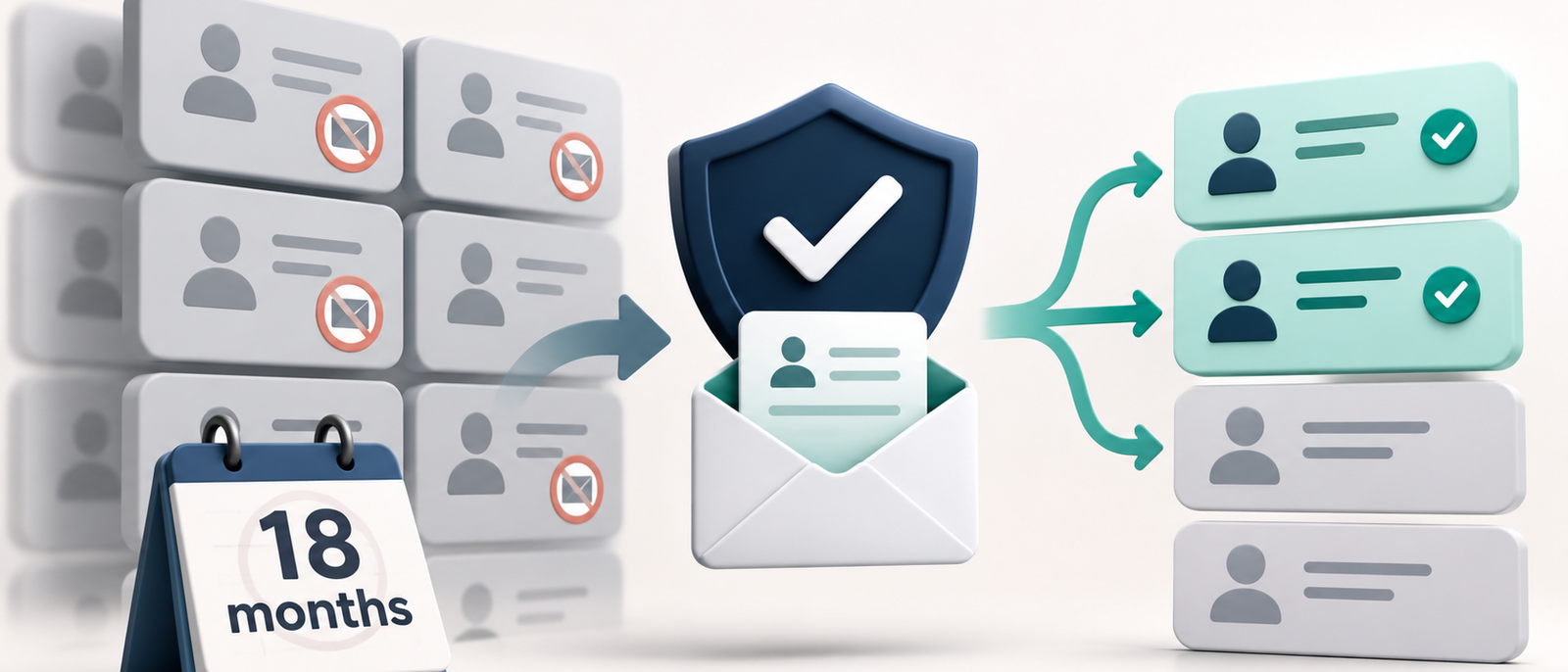
Keap now blocks marketing email to anyone who hasn't opened or clicked one of your emails in 18 months, and buying from you doesn't count. This article explains the rule, why you can't undo it inside Keap, and the lawful way to win those customers back.
When we audited one UK training provider's Keap account, 60% of its contacts had been blocked this way. Many were past customers who had simply never opened a newsletter.
What Keap's 18-month rule is?
Since 30 January 2026, Keap blocks marketing email, in broadcasts and automations, to any contact who hasn't engaged for 18 months or more. It applies to every Keap account (Thryv/Keap help).
Only two actions count as engagement: opening an email and clicking a link in one. Form submissions, website visits and purchases do not (Thryv/Keap engagement policy).
This sits on top of Keap's Automated List Management, which many accounts already had switched on. It moves inactive contacts to Unengaged Marketable after 4 months, and to Unengaged Non-Marketable after a threshold you choose, typically 6 to 18 months (Keap help).
The result: a customer who books with you every year, by phone or invoice, but never opens a newsletter, is treated the same as a dead address.
Why you can't fix it inside Keap?
Keap's own help pages say there is no manual way to mark a blocked contact as engaged or force a send (Thryv/Keap help). The usual workarounds don't help either:
- Bulk opt-in works for Non-Marketable contacts but not Unengaged Non-Marketable ones (Thryv/Keap help).
- The API can't re-opt-in a benched contact. A status write returns success and changes nothing, as Keap's developer forum also reports (Keap community).
- Turning Automated List Management off releases no one. In our testing, the status is stored on each contact; the setting only affects who gets benched next.
- Keap's confirmation email can't reach them in bulk, and its opt-in link only works inside a Keap-sent email.
You can still send benched contacts individual emails, invoices and quotes. But for a list of hundreds, that isn't a marketing channel.
What UK law allows?
Keap's rule is a deliverability policy, not the law. Under the UK's PECR rules, what you may send depends on who the contact is (ICO guidance):
| Contact | What you need to email them marketing |
|---|---|
| Corporate subscriber (a limited company, LLP, public body address) | No consent needed. Identify yourself and offer an opt-out in every email |
| Individual (including sole traders and some partnerships) | Consent, or the "soft opt-in": they bought from you, you're marketing similar products, and they were offered an opt-out when you collected their details and in every email since |
| Individual with neither | Nothing. You can't email them, not even to ask permission |
That last row matters. A "do you still want to hear from us?" email is itself marketing. The ICO has fined companies, including Flybe and Honda in 2017, for sending exactly that kind of email to people they had no right to contact.
So the customers you can win back are your corporate contacts and the individuals who bought from you or gave recorded consent. That is often a smaller list than Keap's blocked total, but it's the most valuable part of it.
We're not lawyers. Take advice if your situation is unusual.
The lawful way to win them back
The method is one honest question, asked once, through a sender that isn't bound by Keap's block, with every answer recorded back in Keap.
- Export fresh data from Keap: contacts and orders, on the same day. A stale export quietly re-includes people who opted out since.
- Sort every blocked contact by lawful basis: corporate, individual with a purchase, individual with recorded consent, or none. Contacts with none are left out completely.
- Remove everyone who must not be emailed: opt-outs, past spam complaints, hard bounces, competitors, anyone already asked, and anyone outside your market. When in doubt, leave them out.
- Check every email domain still accepts mail, so dead addresses don't damage your sending reputation.
- Send one re-permission email through a permission-based sending service. Plain and personal, from a real person at your company, with one "Yes, keep me on the list" button and an unsubscribe link.
- The button opens a Keap landing page with their email filled in. Submitting it tags them in Keap, which records their fresh consent.
- Record every unsubscribe back in Keap within 72 hours, and never treat a bounce as an opt-out.
- Send once only. No reminders. Everyone who said yes is now an engaged contact you can market to with confidence.
Each step is checked before the next: a practice run that sends nothing, a test email to yourself, and a typed confirmation before the real send.
Case study: a UK training provider
A UK instructor-training company had about 3,400 contacts in Keap, and close to 2,000 were blocked. Most were people who had booked courses by invoice or through their employer, then never opened a newsletter.
We ran their corporate contacts first, then their individual customers. Of 1,623 blocked individuals, 268 had a verified purchase and passed every check. On 27 November 2026 all 268 re-permission emails were accepted for delivery, with none failed. Everyone who says yes is back on the list, tagged in Keap with the date of their consent.
Two details made the difference. Accommodation-only bookings counted as course attendance, because employers often paid for the course while the delegate booked the night before. And orders for products since deleted from Keap still counted, because they were real paid orders at course prices.
What not to do?
- Don't import your blocked contacts into another tool and blast them. No consent check, no exclusions and no record back in Keap is how sender reputations, and ICO complaints, happen.
- Don't email individuals who never bought and never consented, even to ask permission.
- Don't re-import contacts into Keap by email address to "reset" them. Keap matches imports on contact ID, so email-keyed imports create duplicate records that land non-marketable anyway.
- Don't switch off Automated List Management expecting it to release anyone. It won't, and it removes the protection for future sends.
- Don't send reminders. One clear ask respects people's time and keeps complaints near zero.
Questions people ask
Is this getting around Keap's rules? No. Keap blocks the sends to protect its shared email network, and we don't use Keap to send to blocked contacts. We ask each customer once, from your own sending domain, and Keap records the answer. Only people who say yes come back.
Will people who say yes stay marketable? Only if they keep engaging. Keap re-blocks contacts who go quiet again, so the tag recorded at confirmation is the lasting record. Build future segments on it.
How long does it take? Typically one to two days of work, depending on the size of your list and how many products you sell.
What about contacts who signed up but never bought? If there's a recorded opt-in, they may qualify. In Keap that evidence often survives only in each contact's status history, so it's checked by hand, case by case.
Does this work outside the UK? The method does, but the lawful-basis rules differ by country. This article covers UK PECR only.
Find out how many customers you could win back
Web Moods can check your Keap account and tell you how many of your blocked contacts you can lawfully contact, before you commit to anything. If the numbers are worth it, we run the whole recovery for you and hand back a clean, consented list inside Keap.
Contact Aziz Meknassi at aziz@web-moods.com or visit web-moods.com.
Sources
- How Email Engagement Affects Your Inbox Placement in Keap (Thryv/Keap)
- 18-month email engagement policy (Thryv/Keap)
- Why Re-Engagement Campaigns Protect Your Business (Thryv/Keap)
- Contact email statuses (Thryv/Keap)
- How to Set Up Automated List Management in Keap (Thryv/Keap)
- Re-engaging "non-marketable" contacts (Keap community)
- How do we comply with the PECR electronic mail marketing rules? (ICO)